
Mold Hiding in Plain Sight: Why Your Home Inspector Matters
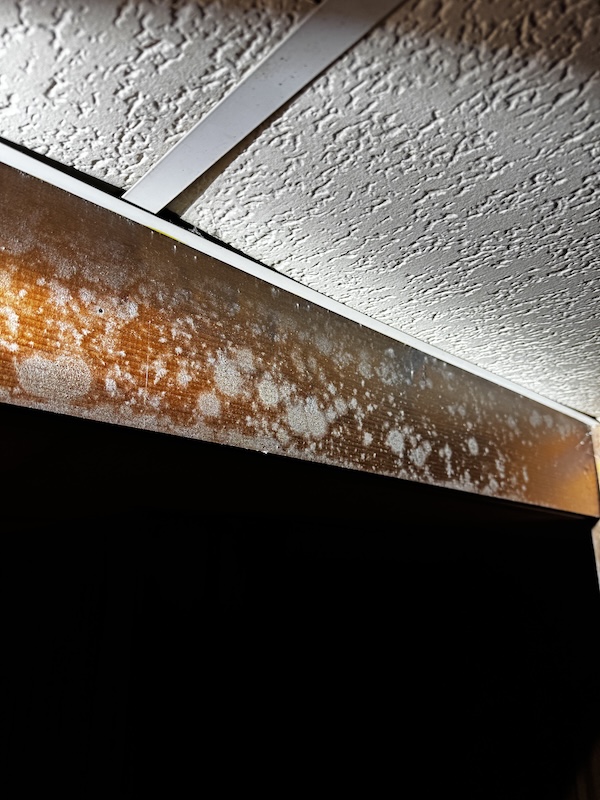
Mold is not always hiding behind drywall, under flooring, or inside a wall cavity. Sometimes it is right in front of you.
The problem is that it does not always look like what people expect.
On a recent inspection, there were areas of wood that looked mostly normal under typical room lighting. At a quick glance, someone could easily walk past them without thinking twice. But when the surface was viewed more closely and illuminated from a different angle, the condition became much more obvious.
The difference between “looks fine” and “this needs a closer look” was not a special machine.
It was the inspection process.
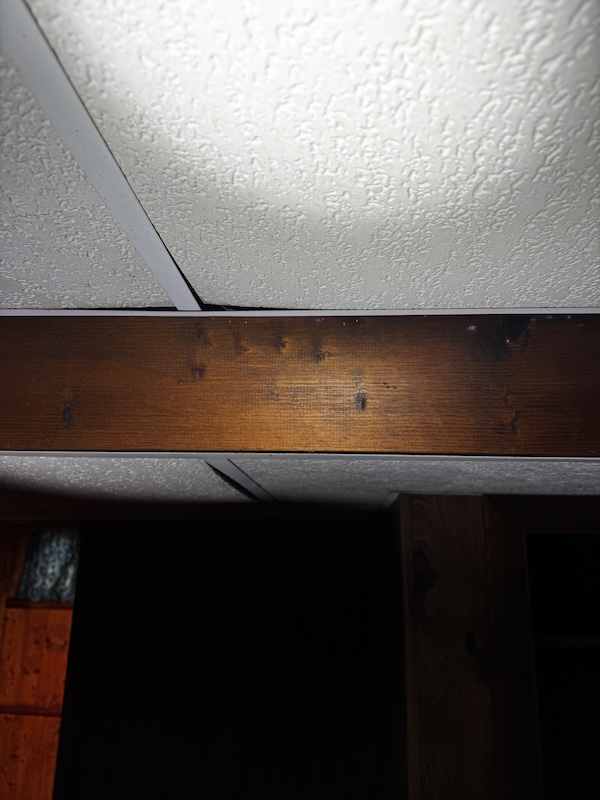
What looked normal at first
In the first photo, the wood surface appears relatively clean. There are some variations in the finish and coloration, but nothing that immediately screams “problem.”
That is exactly why conditions like this can be missed.
A home inspection is not just about standing in the middle of a room and looking around.
An experienced inspector changes perspective.
We get closer.
We change the lighting.
We look across surfaces instead of directly at them.
We compare one area to another.
And we ask why something looks different.
When the same wood was illuminated more aggressively from an angle, widespread surface growth became much easier to see.
The other photos show the same type of condition on structural wood framing. Under direct lighting, what could have blended into the wood finish becomes a much more distinct pattern of light-colored surface growth.
That is mold hiding in plain sight.
We do not let defects find us
This is one of the most important parts of how we inspect homes at Clarity.
A good inspection should not depend on luck.
We do not simply walk through a property waiting for something broken to catch our attention.
We follow a process.
We look at areas where moisture is likely.
We pay additional attention to basements, attics, bathrooms, roof interfaces, plumbing areas, exterior drainage, and other locations where conditions can develop.
When something looks slightly unusual, we do not immediately move on.
We investigate.
That may mean using a flashlight at a low angle across a surface, checking adjacent materials, evaluating moisture conditions, looking for staining, or tracing what is happening elsewhere in the building.
The goal is not to make every condition sound scary.
The goal is to actually see what is there.
Lighting matters more than most people realize
Home lighting is designed to make rooms comfortable, not to expose defects.
Overhead lights illuminate a surface fairly evenly. That can hide texture, staining, residue, waviness, and surface growth.
A flashlight held at a sharper angle can create contrast.
Small changes in the surface suddenly become visible.
This same technique is useful for more than microbial growth. Side lighting can help an inspector identify:
- subtle foundation wall movement
- moisture staining
- drywall irregularities
- surface deterioration
- ceiling defects
- uneven masonry
- repairs and patches that are otherwise difficult to see
The flashlight is simple.
Knowing when and how to use it is the important part.
Does visible growth automatically mean there is a major mold problem?
No.
And this is another place where your inspector matters.
Visible suspected fungal or microbial growth should be documented, but a home inspector should not pretend to know more than the evidence supports.
A photograph alone does not tell us:
- the exact species
- how long it has been present
- whether hidden areas are affected
- whether the condition is active
- the exact moisture source
- whether laboratory testing is necessary
Those questions may require additional investigation or testing.
What the inspector should be able to do is recognize the condition, document where it is present, evaluate surrounding moisture conditions, and recommend an appropriate next step.
That is very different from either ignoring it or frightening the buyer with conclusions that have not been established.
The bigger question is usually: Why is it there?
Cleaning visible growth may address what you can see.
It does not necessarily address why it developed.
Moisture-related conditions can be influenced by many things, including:
- exterior grading and drainage
- foundation moisture
- plumbing leaks
- condensation
- elevated indoor humidity
- poor ventilation
- roof leakage
- air leakage
- improperly exhausted bathrooms or kitchens
That is why inspection should be about more than identifying a spot on a piece of wood.
The inspector should be looking at the house as a system.
If we see growth in a basement, we also want to understand what is happening outside.
If we see staining in an attic, we look at ventilation, roof penetrations, insulation, and air movement.
If we see growth near a bathroom window, we think about humidity and ventilation.
One condition often gives us a reason to look harder somewhere else.
This is why your inspector matters
Most homebuyers will only spend a short amount of time in a property before deciding whether to purchase it.
During that time, they are thinking about bedrooms, kitchens, furniture placement, location, schools, and whether the house feels like home.
Your inspector has a different job.
We are looking for the things that do not immediately stand out.
We are asking:
Why does this area look different?
Where could moisture be coming from?
What is hidden?
What can I actually verify?
What deserves additional investigation?
A thorough inspection is not about finding the most defects.
It is about having a repeatable process that makes important conditions harder to miss.
These photos are a good example.
The condition was visible.
But only if someone knew to look at it the right way.
Facts Without Fear.
That means finding the condition, understanding what we can and cannot determine, and giving the buyer a practical next step.









Leave a Reply
Want to join the discussion?Feel free to contribute!